You are not shopping for a toy. An electric dirt bike is a real vehicle with real speed, and the difference between a great purchase and a bad one is almost never the brand — it's whether the bike matches the rider's weight, whether the brakes and tires can handle the terrain, and whether you actually have a legal place to ride it.
Here's what matters, in the order it matters.
The 60-second version
- Power figures are advertised at peak, not continuous. A "3500W" bike delivers roughly half that in steady state and spikes to 3500W under acceleration or climbing. That spike is what makes the first ten minutes feel violent.
- Rider weight matters more than age. A 110 lb 13-year-old and a 165 lb 16-year-old need different bikes. "Teen" isn't a spec.
- The real safety features are the brakes, the tires, and the helmet — not the display. Parents compare motors for hours and brakes for five minutes. Flip that.
- Legality is local. On private land you need permission. On public land, electric dirt bikes are frequently treated as motor vehicles — which can mean registration, age limits, or an outright ban on trails that allow only bicycles.
Is it legal to ride where you live?
Answer this before you spend money, not after.
There is no single US rule for electric dirt bikes. Three layers apply:
- Safety and labeling — handled at the seller and product level.
- State law — many states class anything above a certain wattage or speed as a motor vehicle, often the same category as a small motorcycle. Some states have explicit "electric off-highway vehicle" rules; others leave it to land agencies.
- The place you actually ride — this is the one that bites. Trail systems that allow bicycles often ban motorized vehicles, and "it's electric" rarely changes the answer.
The practical move: call the park, forest, or trail manager and ask one question — "Are electric dirt bikes allowed on your motorized trails, and is there a minimum age?" Get the answer before you buy. If the only place your teen can ride is your own backyard, that's fine — but size the bike for that reality.
How much power does a teen actually need?
Less than the marketing suggests, and more than a toy offers.
Two motor layouts dominate the category:
- Hub motors — common on 1500W-class bikes. Simple and cheap; power goes straight to the wheel with no chain.
- Mid-drive motors — the 3500W class. The motor drives through a chain and gearing, so it can trade speed for torque. That's why a mid-drive climbs better at the same nominal power.
Then there's the adolescent reality: teens are often lighter than adults, so the same motor feels stronger. A bike that is "just right" for a 190 lb adult is genuinely quick under a 110 lb rider. If your teen is light and brand new to riding, a lower-power bike teaches throttle control with far less chance of a wheelie or a 40 MPH surprise.
Match the bike to the rider's weight and the terrain first. Buy power later, after a season of experience.
Read the spec sheet like a parent
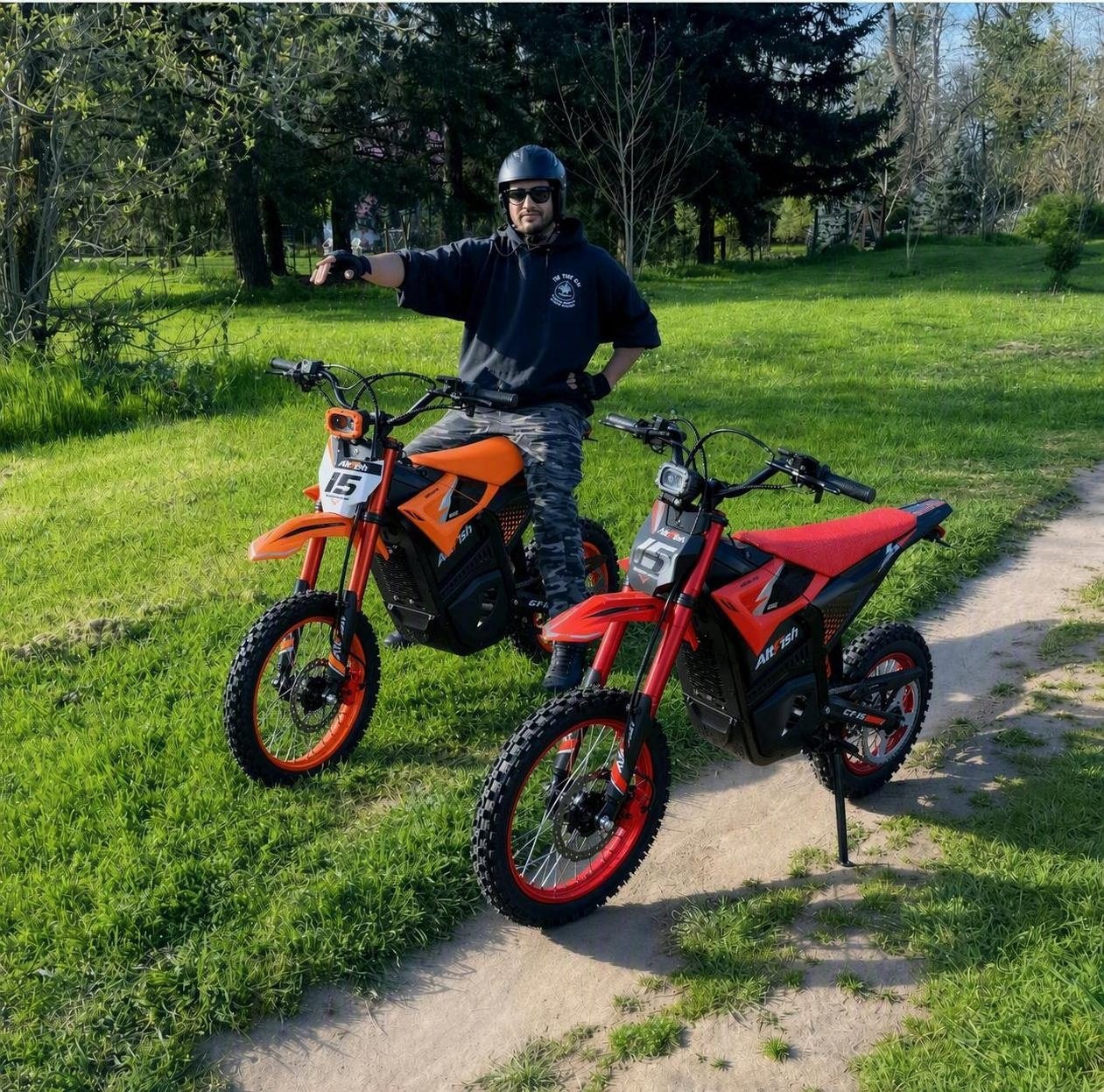
Take a real example — a 3,500W peak mid-drive dirt bike — and read the specs as a parent, not a shopper:
Spec sheet at a glance:
- 3,500W peak brushless mid-drive — Motor output at peak, not sustained — Real acceleration; not a starter bike for a small rider
- 40 MPH top speed — Maximum under ideal conditions — Helmet choice and riding area change completely at this speed
- 40° incline climb — Steepest usable slope — Decides whether your local terrain is ridable
- 48V / 23.8Ah removable battery — About 1,142 Wh of energy — Removable means you can charge and store the pack away from the bike
- Dual hydraulic disc brakes — Hydraulic, not cable-actuated — Shorter, more consistent stopping — the most important single spec here
- Full suspension — Front and rear travel — Keeps tires planted, fewer "the bump threw me off" moments
- Knobby off-road tires — Aggressive tread — Grip on dirt and grass instead of sliding
- 330 lb max load — Rider plus gear — Overloading degrades braking and handling
Notice what isn't on that list: app controls, riding modes, LED displays. They're nice, but they don't slow a bike down when the tires and brakes can't handle the terrain.
Battery safety: what to actually check
Battery fires make headlines because the failure mode is dramatic, not because it's common. Most of the incidents trace back to three things: uncertified packs, wrong or damaged chargers, and charging somewhere nobody would notice a problem until it's too late.
Check these, in order:
- Ask for battery and charger documentation. Any seller should be able to tell you which standards the pack and charger were tested to. On our bikes, the electrical system is CE / FCC / RoHS tested — and if you want deeper detail on a battery, ask before you buy. From us or from anyone else.
- Charge the removable pack off the bike, on a hard, non-flammable surface. Not on carpet, not next to curtains.
- Charge while you're awake and nearby. Not overnight in a bedroom. This single habit prevents most of what you've read about.
- Use the charger that came in the box. No fast-charge adapters, no "compatible" marketplace chargers.
- Retire a pack that's swollen, hot, or smells odd — and don't leave batteries in a hot garage all summer.
Gear checklist for day one
At 40 MPH, bicycle gear is not enough.
- Helmet: full-face, rated DOT or ECE — not a bicycle helmet. If the bike tops out above 25 MPH, treat it as a motorcycle.
- Eye protection: goggles or a visor. Dirt in the eyes causes the crashes nobody mentions.
- Gloves: hands, wrists, and grip when it's hot.
- Boots: above the ankle. The footpeg is where beginners get hurt.
- Knee and elbow pads, chest/back protector: especially the first season.
- Visibility: a light-colored jersey or reflective vest if any part of the ride touches a road.
Budget a real helmet before you budget a second battery. The second battery can wait.
The first-ride plan
Teach in stages, on soft ground, with an adult watching:
- Flat grass or packed dirt, walking pace. Let them find the first few millimeters of throttle. Most beginners use 20% of the throttle and think they're at 80%.
- Braking drills before speed. Ten stops from slow speed, both brakes together.
- Turning before speed. Low-speed figure-eights teach more than a fast lap.
- Hills last. Climbing is where a light rider learns the front wheel can lift.
- Then speed — gradually, and only somewhere a fall means a bruise, not a car.
If your bike has rider-focused settings, use them during this phase. If it doesn't, a light hand on the throttle does the same job.
What it actually costs to own
- Upfront: our 3,500W mid-drive dirt bike is $899, ships free from a California warehouse, and usually arrives in 3–8 business days. That's a full-size machine, not toy-grade.
- Per ride: roughly the cost of electricity. No gas, no oil changes, no spark plugs, no exhaust to repack.
- Long term: tires, brake pads, and eventually a battery pack. Removable packs are replaceable without scrapping the bike — check parts availability before buying any brand.
- Warranty: ours covers 1 year. Confirm what a warranty actually includes (motor? battery? frame?) instead of assuming.
Three mistakes we see families make
- Buying for the teen they'll be in three years. The bike sits in the garage and the first season — the one that decides whether riding sticks — is wasted.
- Skipping the helmet budget. A $40 bicycle helmet at 40 MPH isn't a compromise, it's false confidence.
- No legal place to ride. The bike becomes a driveway ornament and the whole purchase feels like a mistake.
FAQ
What age can a teen start riding an electric dirt bike? It depends on size, maturity, and local rules — there's no single number. Many families start teens around 13–14 on a lower-power bike on private land and move up after a season. Check your state's rules and the rules of wherever you'll ride.
Is 3500W too much for a teenager? For a light, brand-new rider, a full-size 3,500W peak mid-drive bike is a lot of machine — 40 MPH and serious torque. It can be the right second bike, or the right first bike for a larger, athletic teen who has ridden before. Start on soft ground and treat the first month as training.
Do electric dirt bikes need a license or registration? Sometimes. It depends on your state and where you ride. On private land with permission, usually not. On public motorized trails, often yes. Call the land manager and ask.
How long does the battery last on one charge? Real range depends on rider weight, terrain, and throttle use. The 48V 23.8Ah pack holds about 1,142 Wh, and hard climbing or sustained high speed drains it fastest. Plan for well under the best-case marketing numbers, and consider a second pack if range becomes the limit.
Can you ride an electric dirt bike in the rain? Water and electronics don't mix. Light splashes are usually fine; pressure-washing is not, and submerging the motor or battery compartment is a bad idea. Dry and inspect before charging.
Are electric dirt bikes loud? This is one of the genuine advantages. A mid-drive electric bike is far quieter than a gas bike, which makes backyard riding much less of a neighborhood issue — and you can actually talk while riding.
What should I check before buying from any brand? Motor type (hub vs mid-drive), battery capacity in Wh, brake type (hydraulic vs cable), tire type, load rating, warranty coverage, and — the most overlooked — whether replacement parts and batteries are actually available.
Bottom line
Buy the bike that fits your teen's weight and your legal riding area. Put hydraulic brakes and a real helmet ahead of motor wattage. Treat the first month as training. Do that and an electric dirt bike is one of the better things a teenager can own: quiet, cheap to run, and genuinely physical.
Ready to look at the machine? → 3,500W Peak Mid-Drive Electric Dirt Bike — $899, ships from California
Still deciding on the category? Compare electric vs. gas dirt bikes, or read the full electric dirt bike buyer's guide.
Frequently Asked Questions
What age can a teen start riding an electric dirt bike? It depends on size, maturity, and local rules — there\
Is 3500W too much for a teenager? For a light, brand-new rider, a full-size 3,500W peak mid-drive bike is a lot of machine — 40 MPH and serious torque. It can be the right second bike, or the right first bike for a larger, athletic teen who has ridden before. Start on soft ground and treat the first month as training.
Do electric dirt bikes need a license or registration? Sometimes. It depends on your state and where you ride. On private land with permission, usually not. On public motorized trails, often yes. Call the land manager and ask.
How long does the battery last on one charge? Real range depends on rider weight, terrain, and throttle use. The 48V 23.8Ah pack holds about 1,142 Wh, and hard climbing or sustained high speed drains it fastest. Plan for well under the best-case marketing numbers, and consider a second pack if range becomes the limit.
Can you ride an electric dirt bike in the rain? Water and electronics don\
Are electric dirt bikes loud? This is one of the genuine advantages. A mid-drive electric bike is far quieter than a gas bike, which makes backyard riding much less of a neighborhood issue — and you can actually talk while riding.
What should I check before buying from any brand? Motor type (hub vs mid-drive), battery capacity in Wh, brake type (hydraulic vs cable), tire type, load rating, warranty coverage, and — the most overlooked — whether replacement parts and batteries are actually available.